How Much Insulation Do I Need?
Measure the net area you will cover, then divide by the square feet printed on the insulation package you are buying.
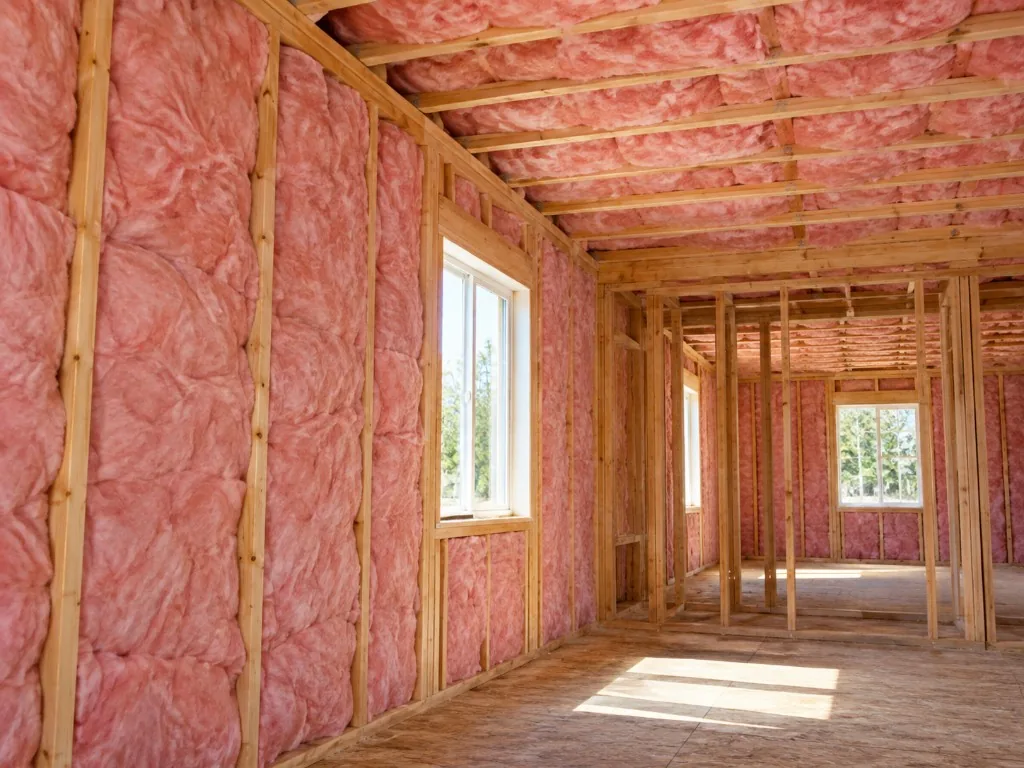
Measure the surface, then subtract openings
Insulation quantity starts with area. A rectangular wall is length times height. An attic floor or a flat ceiling is length times width. A wall 10 feet by 8 feet is 80 square feet. An attic 20 feet by 30 feet is 600 square feet. A ceiling 12 feet by 10 feet is 120 square feet.
Openings you do not intend to insulate come off that area. One 3 foot by 4 foot window on the 80 square foot wall removes 12 square feet and leaves 68. If the openings add up to more than the surface, the measurement needs another look before you buy.
If you only need room area and you are not ready to convert it into packages, the square footage calculator covers rectangular floor area. Come back here when you have a package label.
Read the coverage on the package
Manufacturers print how many square feet a batt bundle, roll, foam package, or loose-fill bag covers. That figure is specific to the product, the thickness, and, for blown-in material, the installed depth. A product type such as fiberglass or mineral wool is not a coverage amount by itself.
Divide the area you need by that labeled coverage and round up to a whole package. When the area is an exact multiple, do not add another package. Eighty square feet of wall and a label that says 40 square feet is 2 packages, with no leftover nominal coverage. A custom product labeled 80 square feet for the same wall is 1 package.
Ten percent waste on that 80 square foot wall raises the planning area to 88 square feet. At 40 square feet per package, you would buy 3 packages. Those packages nominally cover 120 square feet, so 32 square feet is excess coverage, not a promise that the offcuts will fit the next bay.
Batts, boards, and blown-in material
Fiberglass and mineral wool batts use the square feet on the bundle. The same 80 square foot wall and the same 40 square foot label both need 2 packages. Entering an R-value or a 3.5 inch thickness does not change that count. Thickness is not a substitute for the R-value printed on the package, and two materials of equal thickness are not assumed to match.
Rigid foam is sold as boards. A 4 foot by 8 foot board covers 32 square feet. The 80 square foot wall needs 3 boards. If the package contains 2 boards, you buy 2 packages, which is 4 boards and 128 square feet. Excess against an 80 square foot planning area is 48 square feet.
Blown-in insulation needs the bag’s coverage at the depth and R-value you intend to install. Without that row from the bag chart, there is no responsible bag count. A bag that lists 40 square feet at your chosen depth covers the 80 square foot example in 2 bags. A different depth is a different number.
R-value is a separate question
R-value describes resistance to heat flow for a stated product and installation. It does not tell you how many square feet are in the bag. A target you type, such as R-20, can be compared with a selected product such as R-13. The comparison can warn you that the product is below the target you entered. It will not convert that gap into extra layers, and it will not claim that the wall meets a code.
ENERGY STAR, a U.S. Department of Energy program, publishes recommended insulation levels for retrofitting existing wood-framed buildings, by climate zone: Recommended Home Insulation R-Values. Read the current table for your zone. Compression, gaps, and settled depth can reduce the performance you actually get.
A short purchasing example
Wall: 10 ft × 8 ft. Coverage on the label: 40 ft². Waste: 0. Result: 80 ft² net, 2 packages, excess 0. If you enter $15 per package, the material illustration is $30.
Change only the waste to 10 percent: planning area 88 ft², 3 packages, excess 32 ft². At $1 per square foot, that planning area is $88. The per-square-foot price does not also charge you for the leftover coverage in the third package.
Those dollar figures are examples of a price you type. They are not store prices. Labor, tax, delivery, rental equipment, vapor barriers, fasteners, air sealing, and disposal are separate.
Quick reference: packages for a 600 square foot attic
The package count depends entirely on the coverage printed on the label. This table uses the 20 by 30 foot attic from the start of this guide (600 square feet) and rounds each result up to a whole package.
| Coverage per package | Packages at 0% waste | Packages at 10% waste (660 ft²) |
|---|---|---|
| 40 ft² | 15 | 17 |
| 50 ft² | 12 | 14 |
| 75 ft² | 8 | 9 |
| 100 ft² | 6 | 7 |
Notice that the same attic can need anywhere from 6 to 17 packages. That is why a count without the label coverage is not a useful number.
Typical areas to measure
| Surface | Example size | Area |
|---|---|---|
| Attic floor over a small house | 20 × 30 ft | 600 ft² |
| Two-car garage ceiling | 20 × 20 ft | 400 ft² |
| Bedroom ceiling | 12 × 10 ft | 120 ft² |
| Exterior wall run | 40 ft long × 8 ft high | 320 ft² before openings |
| Basement rim joist | 120 ft perimeter × 10 in high | 100 ft² |
Faced, unfaced and adding a second layer
Faced batts have a paper or foil layer on one side. Unfaced batts do not. Whether a facing or a separate vapor retarder is needed depends on your climate zone and local code, so check before you buy. When you add a second layer over existing attic insulation, unfaced material is commonly used so that two facings do not trap moisture between layers. The second layer is counted with the same method: area to cover divided by the coverage on the label.
Laying a second layer at right angles to the first helps cover the tops of the joists. Avoid compressing either layer, because compressed insulation does not deliver the R-value printed on the package.
Mistakes that change the order
- Copying coverage from a different thickness, a different R-value row, or a different brand.
- Forgetting a door or window, or subtracting an opening twice.
- Buying individual foam-board math when the store only sells full packages.
- Treating a climate-zone table as a substitute for the coverage label.
Frequently asked questions
How many rolls of insulation do I need for 1,000 square feet?
Divide 1,000 by the coverage on the roll. A roll labeled 40 square feet needs 25 rolls, or 28 with a 10 percent allowance. A roll labeled 75 square feet needs 14, or 15 with the allowance.
Do I subtract the studs or joists from the area?
No. Batt and roll coverage is usually stated for the framed area at a given framing spacing, such as 16 or 24 inches on center. Measure the whole wall or attic floor and match the product width to your framing spacing.
Can I put new insulation on top of old insulation?
Often yes, as long as the old insulation is dry and in good condition. Fix roof leaks and seal air gaps first. Wet, moldy or damaged material should be removed rather than covered.
Is a higher R-value always better?
A higher R-value means more resistance to heat flow, but the useful target depends on your climate zone and where the insulation goes. The ENERGY STAR table linked above is a good place to compare your current level with recommended levels.
How much extra should I buy for blown-in insulation?
Use the bag chart for the depth you plan to install. Loose fill settles over time, so many charts list both the installed and the settled thickness. Plan from the chart row that matches your target R-value.
Use the insulation calculator
Enter the surfaces and the label coverage on the insulation calculator. Keep the package chart next to the result, and check the ENERGY STAR zone table before you decide that the R-value on the bag is the one you want.
Try a related calculator
Run the numbers for your own project with the matching CostRafter calculator.
More in Insulation
See the published calculators and guides collected under this topic.
Open Insulation topic →