How Much Paint Do I Need for a Room?
Estimate paint for walls and ceilings by calculating surface area, subtracting doors and windows, applying coats and coverage rates, then converting to gallons or liters.
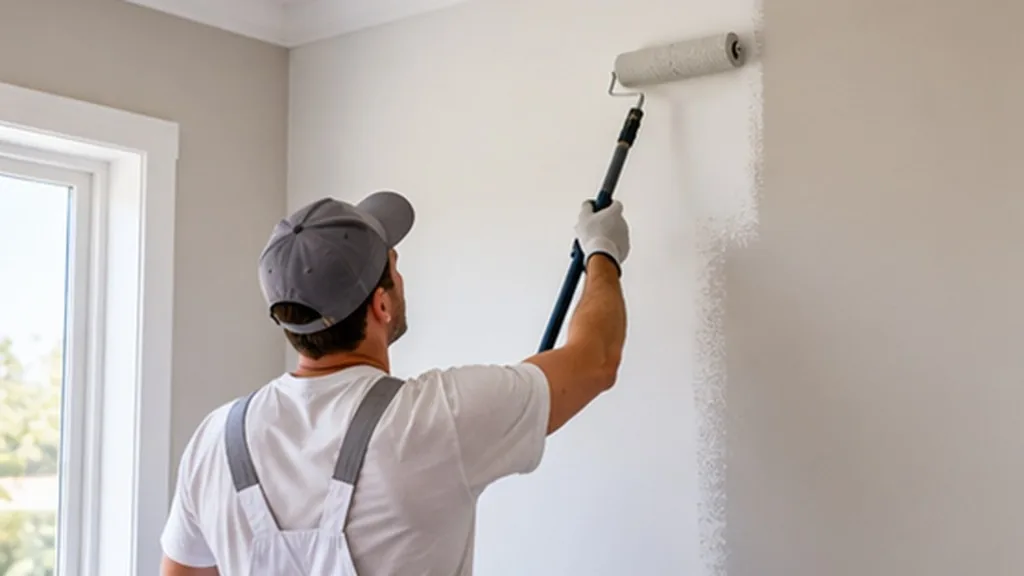
Start with the surfaces you will paint
Paint quantity depends on paintable area, number of coats, and the coverage rate printed on the can—not on room “square footage” alone. Floor area helps with flooring; wall and ceiling area drive paint.
This guide walks through a practical estimate for a typical rectangular room. Texture, primer needs, color changes, and application method can increase real consumption.
Wall area calculation
For a rectangular room, a common wall-area estimate is:
Wall area = 2 × (length + width) × height
That wraps all four walls. Measure interior length, width, and ceiling height in the same units.
Doors and windows
Subtract openings you will not paint (or that reduce wall area):
Net wall area = wall area − (door areas) − (window areas)
If you do not measure each opening, planning defaults are often about 21 ft² per door and 15 ft² per window. Measure large patio doors or picture windows instead of relying on defaults.
Ceiling coverage
Ceiling area for a rectangle is simply:
Ceiling area = length × width
Add ceiling area only when you plan to paint it. CostRafter lets you include or exclude ceilings per room.
Multiple coats
Most interior jobs use two finish coats after any primer. Multiply paintable area by the number of coats:
Coat-adjusted area = net paintable area × coats
Dramatic color changes, deep colors, or bare drywall may need primer plus extra finish coats—check the product label.
Coverage rates, gallons, and liters
Coverage is usually listed as square feet per gallon or square meters per liter. A frequently cited planning rate for smooth interior walls is about 350 ft² per gallon per coat, but always prefer the manufacturer’s number for your product and surface.
Gallons ≈ coat-adjusted area ÷ coverage (ft²/gal)
Convert gallons to liters by multiplying by about 3.785 when comparing metric labels.
Worked example (verified)
Room: 12 ft long × 10 ft wide × 8 ft high, walls only, 1 door and 1 window, using 21 ft² and 15 ft² opening defaults, 2 coats, 350 ft²/gal, and 10% waste.
- Gross wall area: 2 × (12 + 10) × 8 = 352 ft²
- Openings: 21 + 15 = 36 ft²
- Net wall area: 352 − 36 = 316 ft²
- Two coats: 316 × 2 = 632 ft²
- Paint volume: 632 ÷ 350 ≈ 1.81 gallons
- With 10% waste: ≈ 1.99 gallons
Those results match CostRafter’s Paint Calculator for the same inputs (rounded display values: 316.0 ft² net walls, 1.8057 gallons, 1.9863 gallons with waste).
Allowance assumptions
- Waste covers roller loss, touch-ups, and surface texture—not a second color change.
- Porous new drywall often needs primer; primer quantity is separate unless the label says otherwise.
- Ceilings, trim, and doors are separate scopes if they use different products.
Use the paint calculator
Model one or more rooms, openings, coats, coverage units, and optional waste in the Paint Calculator to refine the estimate before you buy.
Assumptions and limitations
- Assumes rectangular rooms and flat surfaces.
- Does not account for heavy texture, brick, or spray application efficiency.
- Does not invent paint prices; optional cost fields use values you enter.
- Always reconcile with the product data sheet and a sample patch on your actual wall.